It operates globally, seeking new alternatives for products used in pre-hospital care (PHC) routines.
Challenge
The requirement was to develop a specific solution for a piece of rescue equipment, rather than simply adapting a conventional caster.
Solution
Development of a fully customized 200mm caster, designed to withstand the extreme conditions encountered in pre-hospital care.
Result
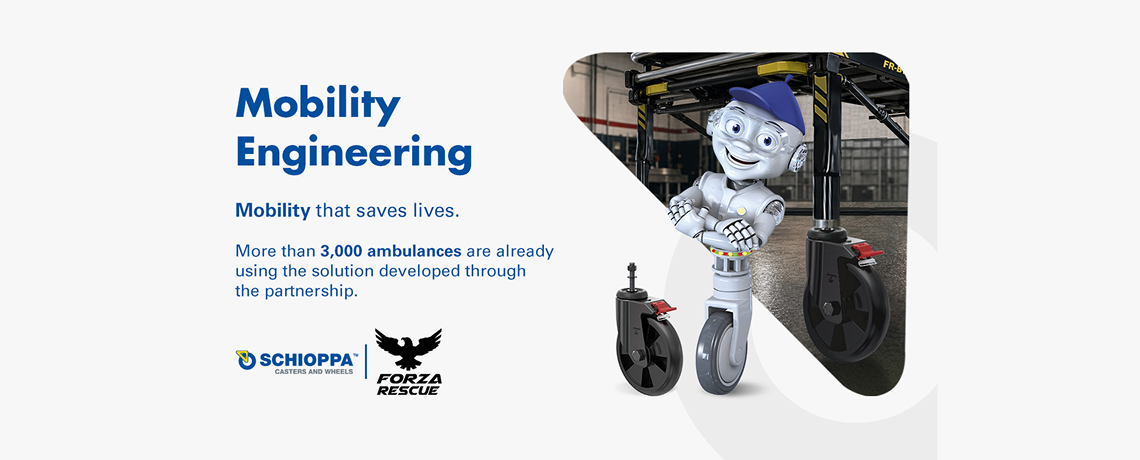
More than 3,000 ambulances are already equipped with this solution.
The objective
In prehospital emergency care, every second counts. Stretchers must be moved quickly through hospitals and along streets and sidewalks, across uneven floors and dirt roads, and over obstacles, while maintaining patient stability and reducing the physical effort required from rescue personnel.
The Challenge
Before working with Schioppa, Forza Rescue had adapted an off-the-shelf caster originally designed for a different application. Although it partially met their needs, it had limitations in key areas, including:
01
Durability under demanding operating conditions;
02
Impact absorption;
03
Stability on uneven surfaces;
04
Ability to overcome obstacles;
05
Integration with the stretcher design.
The goal was to develop a solution specifically engineered for rescue equipment, rather than simply adapting a conventional caster.
Solution and application
ENGINEERING THE SOLUTION
01- CASTERS
Engineering the Solution
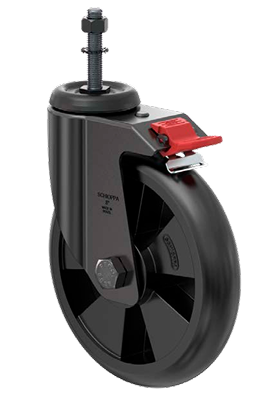
Working closely with the Forza Rescue team, Schioppa developed a custom-designed 200 mm caster, designed to withstand the extreme conditions encountered in prehospital emergency care.
The project focused on addressing the limitations of the casters previously used, delivering an effective solution tailored to the application.
Rather than simply supplying a component, Schioppa contributed to the equipment's engineering process, developing a solution aligned with the application's specific requirements.
Schioppa’s custom caster
02- ERGONOMICS
Ergonomics that protect those who save lives
Operators noticed the difference right away.
The larger wheel diameter significantly reduced the effort required to maneuver the stretcher over thresholds, bumps, and uneven surfaces.
In practical terms, this means:
Less physical effort for rescue personnel;
Easier, more comfortable handling;
Greater control of the stretcher;
Reduced fatigue during critical emergency operations.
When operators need to exert less force, they can devote more attention to what matters most: the patient.
03- SAFETY
Safety for Patients and Rescue Teams
The new solution significantly improved stretcher stability.
Impact absorption reduced the transmission of vibrations to the equipment and the patient, while making movement more predictable, even in challenging environments.
Key benefits include:
Reduced sudden impacts;
Greater directionalcontrol;
Improved stability on uneven surfaces;
Safer patient transport.
In rescue equipment, safety is not an added benefit. It is an engineering requirement.
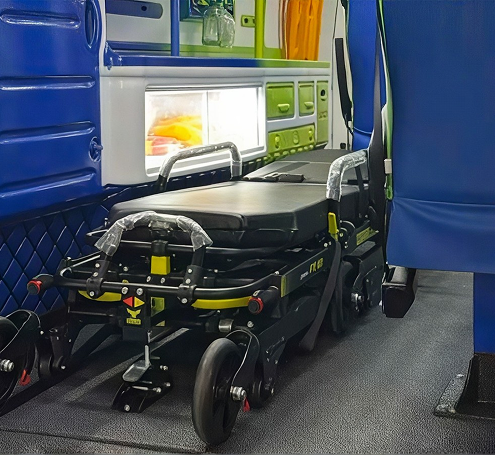
Schioppa’s custom caster installed on a stretcher.
key achievements
GREATER OPERATIONAL EFFICIENCY
Improved mobility enhanced the operational capabilities of the stretchers.
Locations that were previously difficult to access can now be reached more quickly and safely.
The observed benefits include:
01
Quicker stretcher transport;
02
Easier access to challenging locations;
03
Faster stretcher movement;
04
Greater efficiency for rescue teams.
More than 3,000 ambulances
More than 3,000 ambulances are already equipped with this solution.
Lower operating costs
In addition to the ergonomic and operational benefits, the solution's robust design extended the service life of the entire assembly.
When mobility improves, the entire operation moves faster.
Lower operating costs
Reduced impacts help protect not only the casters but also the stretcher frame, reducing the need for corrective maintenance and increasing equipment availability.
For emergency services, this means: less equipment downtime and greater fleet reliability.
Mobility Engineering
The Schioppa and Forza Rescue collaboration demonstrates that a caster can do much more than enable movement.
Through application engineering, a purpose-designed solution can improve operator ergonomics, enhance patient safety, increase operational efficiency, and reduce the total cost of ownership.
At Schioppa, every project starts with a simple principle:
We don't just manufacture casters. We develop mobility solutions for critical applications where performance, reliability, and safety make all the difference.
SCHIOPPA
Moving the world for you!
Need a custom-tailored handling solution for your operation? Speak with a Schioppa expert.